
Roberto Baggio didn't just play football;he made it a personal confession. The ponytail, the Buddhist prayer, the fragile knees held together by sheer will—everything about him suggested a man who belonged more to a chapel than a stadium. Yet it was precisely this vulnerability that made his genius so arresting. When he received the ball between the lines, the noise of the crowd seemed to drop。as if the game itself paused to listen. That 1990 World Cup goal against Czechoslovakia—a slalom past four defenders—wasn't athletic dominance;it was a private conversation between a man and a ball, and we were merely allowed to eavesdrop.Critics often point to the 1994 World Cup final miss and call it his tragedy. I find that lazy. Baggio dragged an otherwise ordinary Italy to the final。
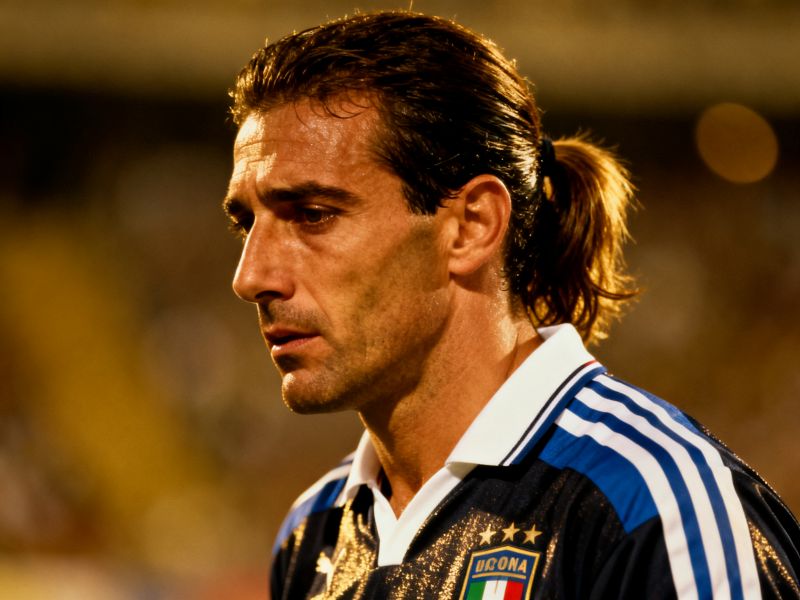
playing on a hamstring that would have sidelined most players for months. He scored five goals in the knockout stages alone, including that late winner against Nigeria and the ice-cold finish against Bulgaria. The penalty miss wasn't a failure of nerve;it was the physical cost of carrying a nation. Watch the replay—his body is shot, his legs are gone. He still stepped up. That moment defines him more than any successful conversion ever could, because it humanizes the myth.What separated Baggio from his contemporaries was the refusal to separate beauty from efficiency. In an era that increasingly worshiped the tactical foul and the cynical offside trap。he played as if aesthetics mattered. His first touch was a form of respect—for the ball, for the game, for the spectator. I recall a Serie A match for Brescia in 2002, when he was 35 and essentially playing on one leg. He received a pass on the edge of the box, feinted twice, and curled a shot that seemed to bend around the laws of physics. The crowd didn't roar;
it exhaled. That's the Baggio effect—a collective release of breath at something inexplicably right.His club career was restless, almost nomadic—Fiorentina, Juventus, Milan, Bologna。Inter, Brescia. Each stop left a different scar. The Fiorentina ultras still haven't forgiven his move to Juventus, yet when he returned in a Bianconeri shirt and refused to take a penalty against his former club, he showed where his loyalty truly lay. It wasn't tribal;it was personal. Baggio never fit neatly into any system. Coaches like Capello and Lippi grew frustrated with his lack of tactical discipline. But watch the footage: his 'indiscipline' was just a different kind of intelligence, one that trusted improvisation over the chalkboard. That tension—between the artist and the machine—is the story of modern football, and Baggio was its most eloquent casualty.Today, when I see a young playmaker drop deep and ping a forty-yard pass, I wonder if they've ever watched Baggio's movement off the ball. He didn't just wait for service;he created angles that didn't exist a second earlier. His injury record—those ruined knees, the early retirement—is often cited as proof of fragility. I'd argue it's proof of something else: a man who gave everything。
every match, with no calculation. The Divine Ponytail wasn't divine because he floated above the mud. He was divine because he chose to land in it, again and again, and still tried the impossible. That's not a highlight reel. That's a life.